About me
I'm a Ph.D. candidate in Electrical and Computer Engineering at UC Santa Barbara, advised by Prof. Upamanyu Madhow and supported as a Semiconductor Research Corporation (SRC) Research Scholar. Before UCSB, I earned my B.S. in Electrical and Electronics Engineering from Koç University in Istanbul, where I also completed a B.A. in Philosophy.
My research lies at the intersection of signal processing and machine learning for next-generation wireless systems. I'm interested in developing scalable architectures and uncovering fundamental principles that guide system design. Right now, I'm working on beamspace processing for massive MIMO, exploring how dimensionality reduction can enable practical modem designs, as well as AI/ML-based positioning using wireless digital twins built with NVIDIA Sionna.
More broadly, I care about bridging theory and practice in wireless communications: information-theoretic limits, performance versus complexity tradeoffs, and making signal processing work under real hardware constraints like low-resolution ADCs.
If any of this overlaps with your own work or interests, I'd love to hear from you ☕
Projects
Positioning with Cellular MIMO Using Wireless Digital Twins
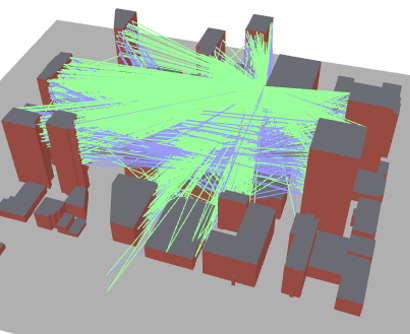
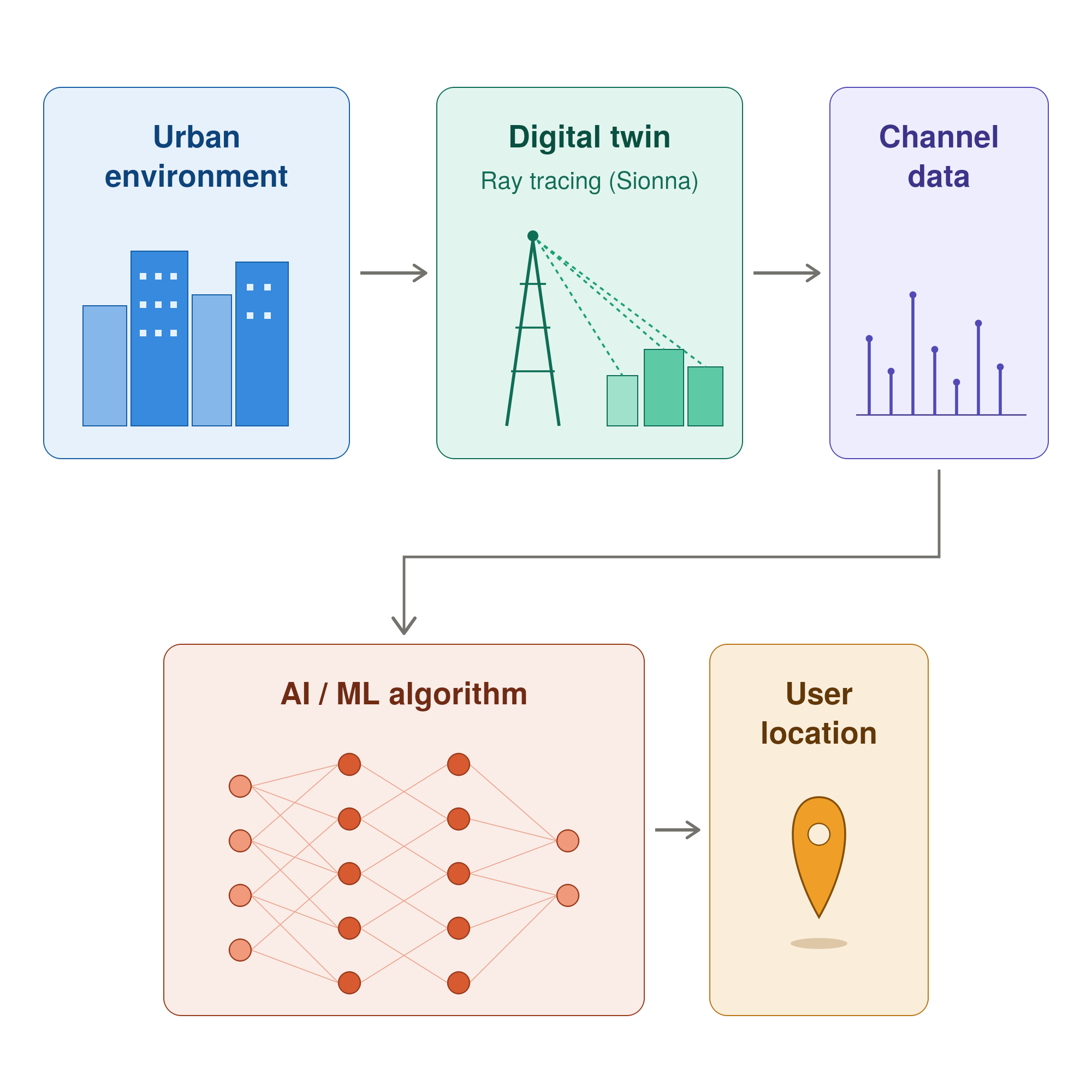
How can we use existing cellular infrastructure to locate users?
We are developing AI/ML-based positioning algorithms for realistic urban environments, using NVIDIA Sionna to generate synthetic channel data from site-specific wireless digital twins. Alongside the algorithmic work, we are interested in the fundamental estimation-theoretic limits on what any positioning system can achieve in these settings. The primary focus is FR3 bands. This work is a collaboration with Prof. Tingjun Chen's group at Duke University.
Beamspace Processing for Scalable Massive MU-MIMO
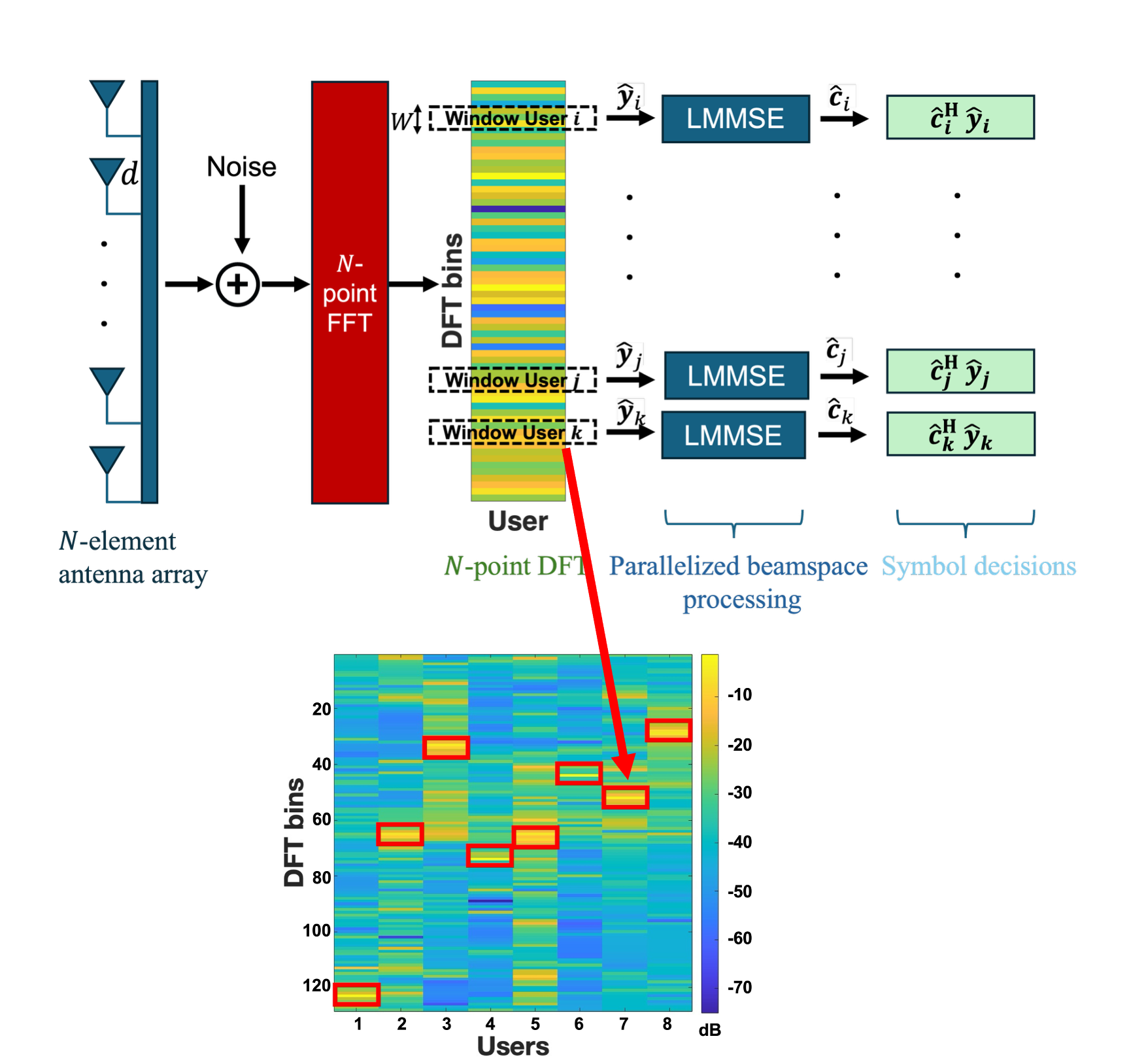
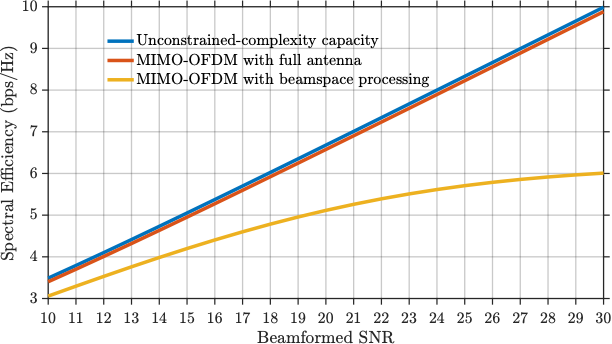
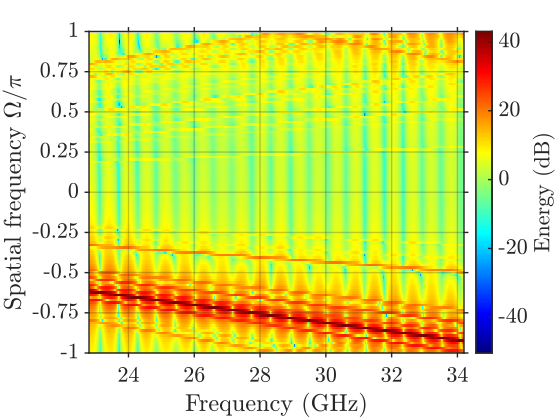
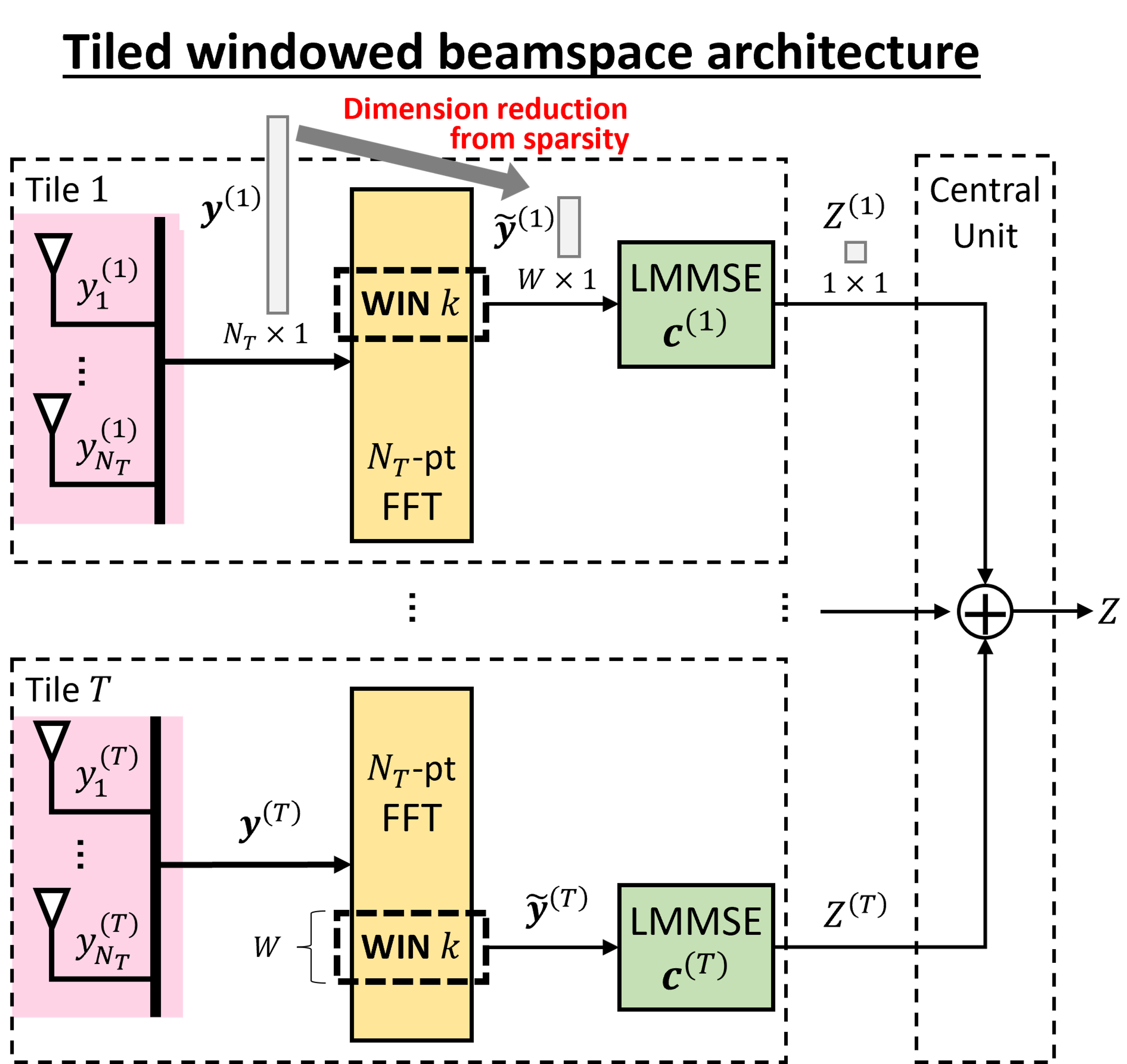
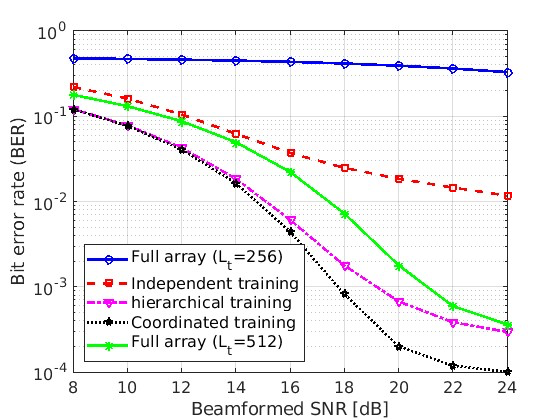
As arrays get larger, the computational complexity gets impossibly expensive. Can we throw most of it away and still get the same performance?
Larger antenna arrays and wider bandwidths promise higher data rates, but at the cost of prohibitive hardware and signal-processing complexity. Beamspace dimensionality reduction offers a way out: transforming the received signal into a spatial-frequency representation concentrates channel energy into a few beams, letting the receiver operate in dramatically reduced dimension. On the fundamentals side, we characterize information-theoretic limits and develop a geometric understanding of interference geometry, validated on measured 28 GHz channels. On the design side, we develop hardware-efficient architectures, including algorithms for severely quantized receivers and tiled layouts that ease packaging constraints. Our LMMSE-based adaptive multiuser detector for tiled beamspace architectures achieves lower BER than conventional LMMSE while reducing training overhead, and remains scalable under realistic power and interconnect constraints. The tiled architecture work is a collaboration with Prof. Zhengya Zhang's group at the University of Michigan.
- [1] C. Cebeci, O. Delafrooz Noroozi, U. Madhow, "Beamspace Dimensionality Reduction for Massive MU-MIMO: Geometric Insights and Information-Theoretic Limits," submitted for publication, 2025. arXiv:2512.06234.
- [2] C. Cebeci*, O. Delafrooz*, U. Madhow, "Scaling mmWave MU-MIMO: Information-Theoretic Guidance using Real-World Data," 58th Asilomar Conference on Signals, Systems and Computers, 2024. [IEEE]
- [3] J. Han, C. Cebeci, W. Tang, Z. Zhang, U. Madhow, "Tiled Beamspace Processing for Scaling mmWave Massive MU-MIMO," 2024 IEEE 100th Vehicular Technology Conference (VTC2024-Fall), Washington, DC, USA, 2024, pp. 1–6. [IEEE]
Wideband Hybrid Beamforming for Sub-THz Communication
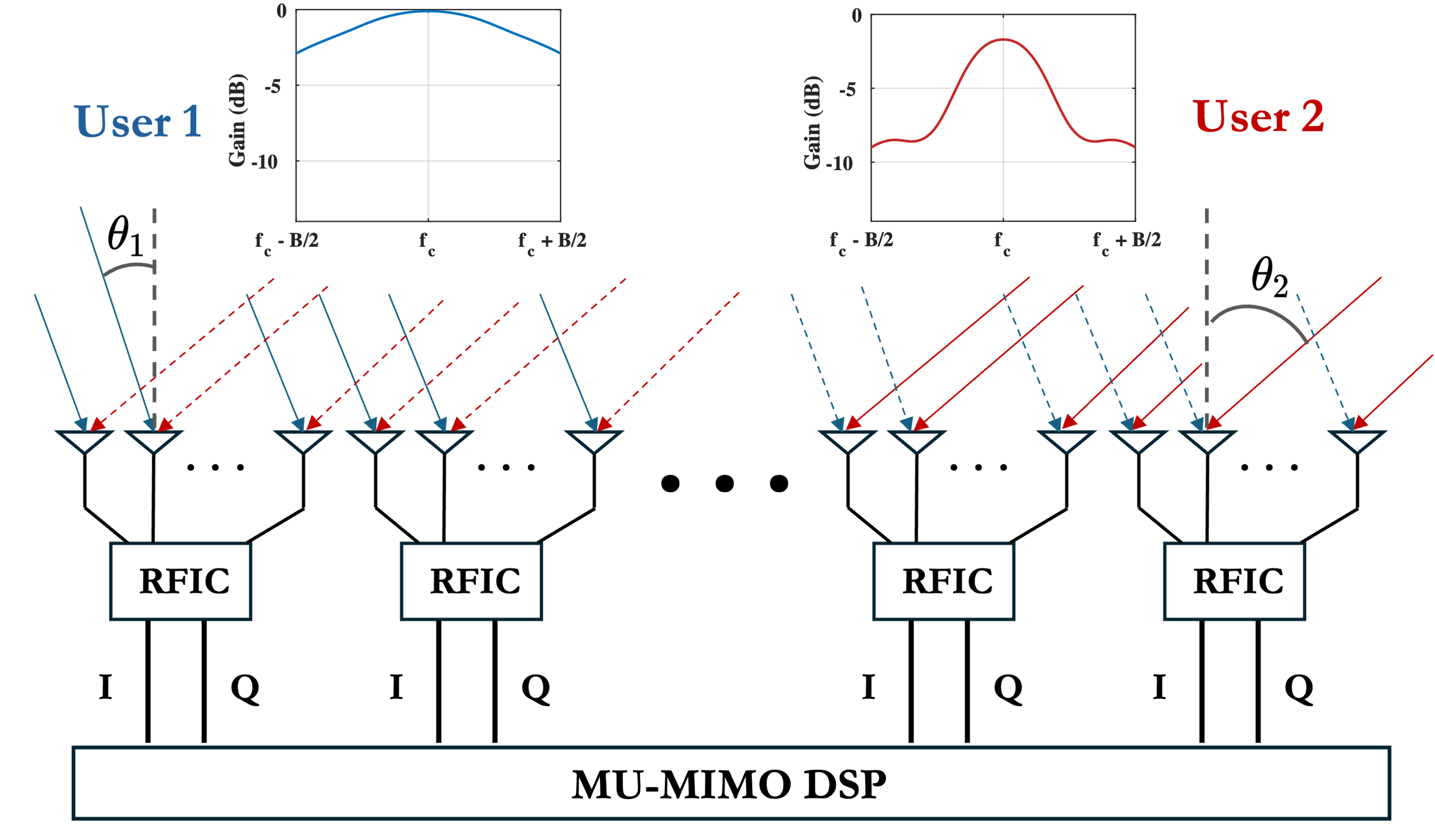
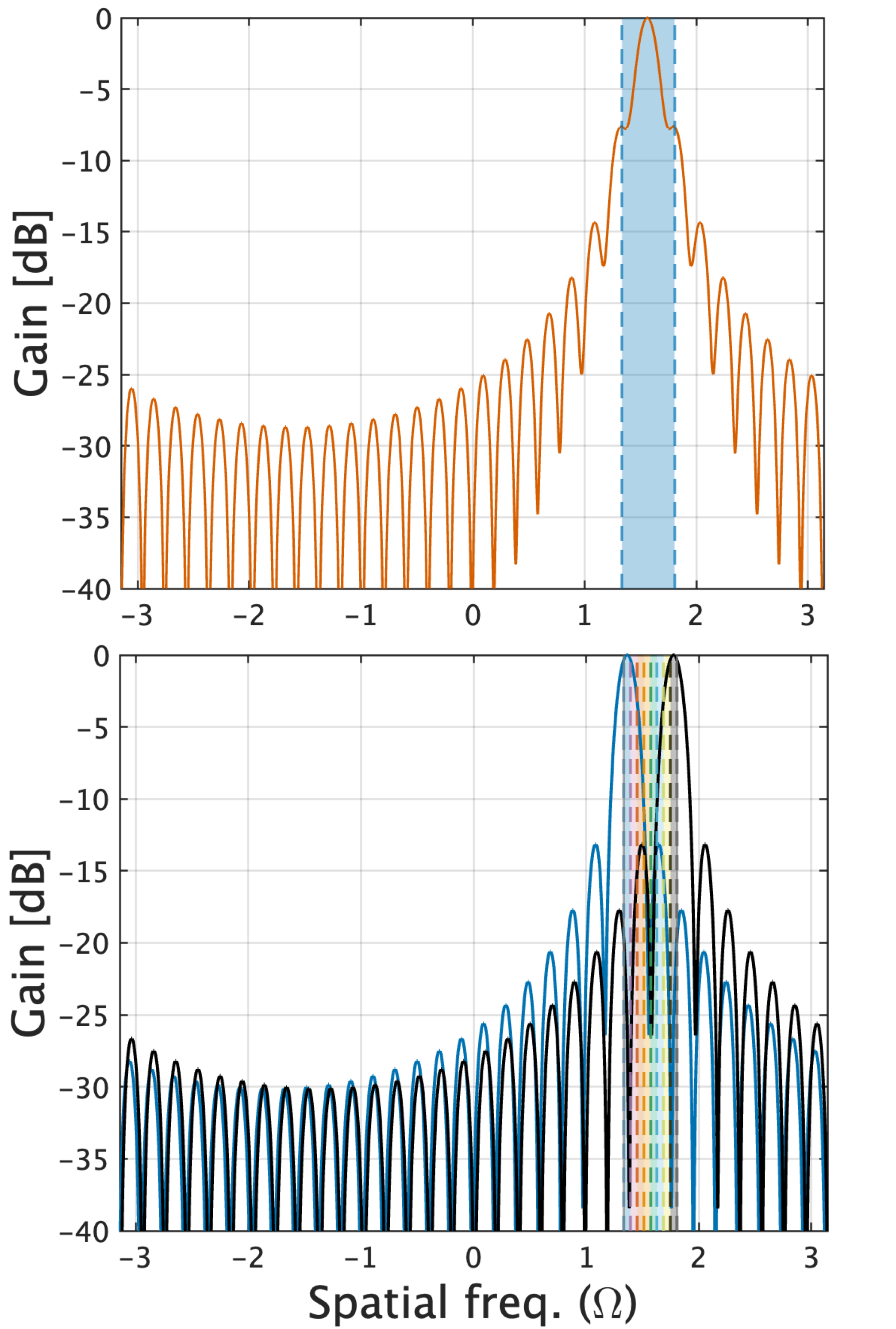
As we scale sub-THz networks to wider bandwidths and larger arrays, how do we design power-efficient receivers that can handle frequency-dependent beam squint and multiuser interference?
At sub-THz carriers with a large fractional bandwidth, fully digital arrays become impractical: high-speed data converters and downconversion stages dominate power consumption. We study a tiled hybrid beamforming architecture in which each tile is a phased subarray performing analog RF beamforming, followed by digital MU-MIMO processing. Using information-theoretic benchmarks, we compare RF beamforming strategies that mitigate beam squint via quadratic-phase broad beams. The encouraging finding is that simple phase-only RF beamformers paired with broad beams match or outperform more complex strategies requiring joint amplitude and phase control.
- [1] A. Haddad, O. Delafrooz Noroozi, C. Cebeci, M. J. W. Rodwell, U. Madhow, "Scaling Wideband Hybrid Beamforming for sub-THz Communication," 59th Asilomar Conference on Signals, Systems and Computers, 2025 (Invited). arXiv:2512.06532.
Fourier Analysis of Digital Beamforming with 1-bit ADCs
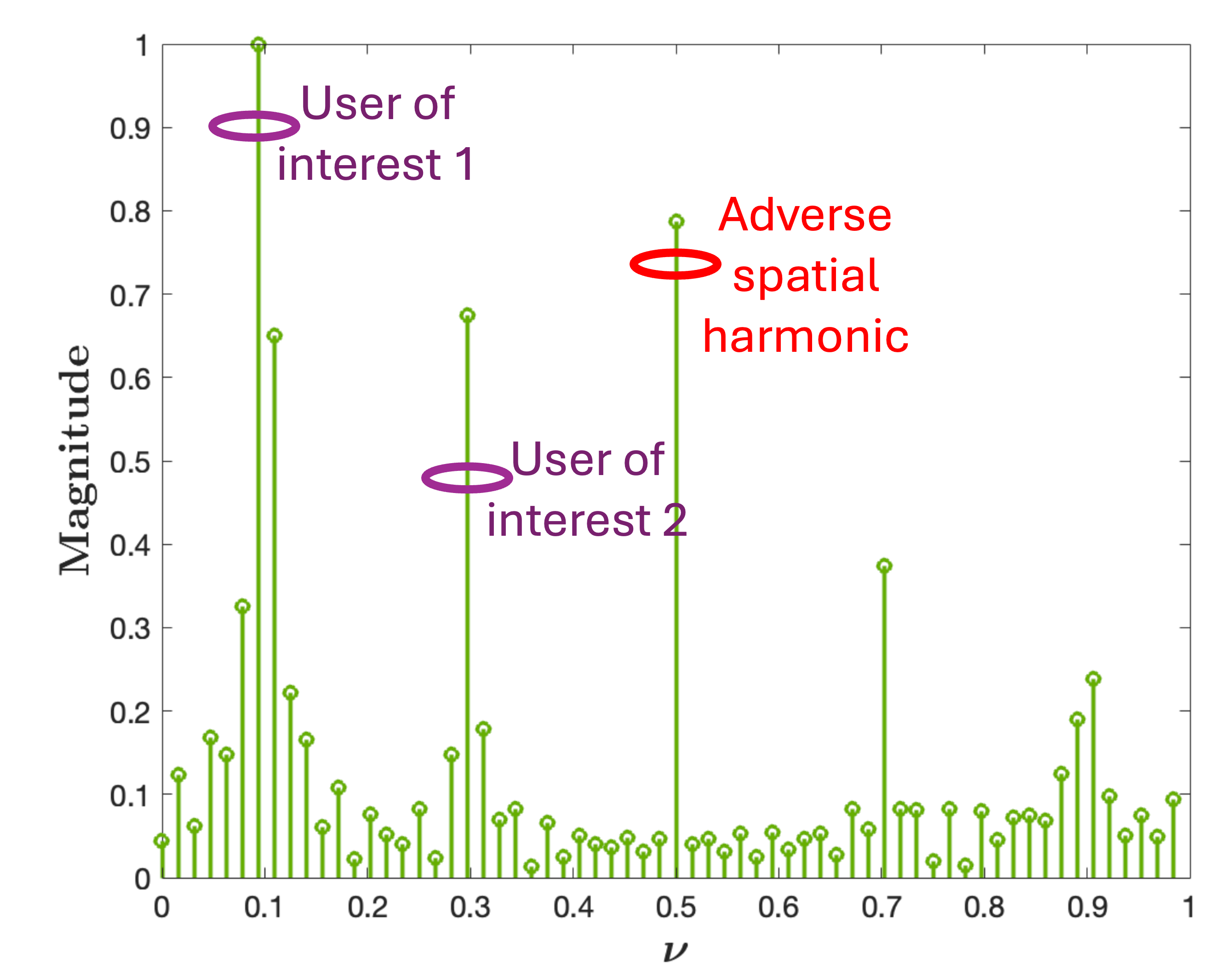
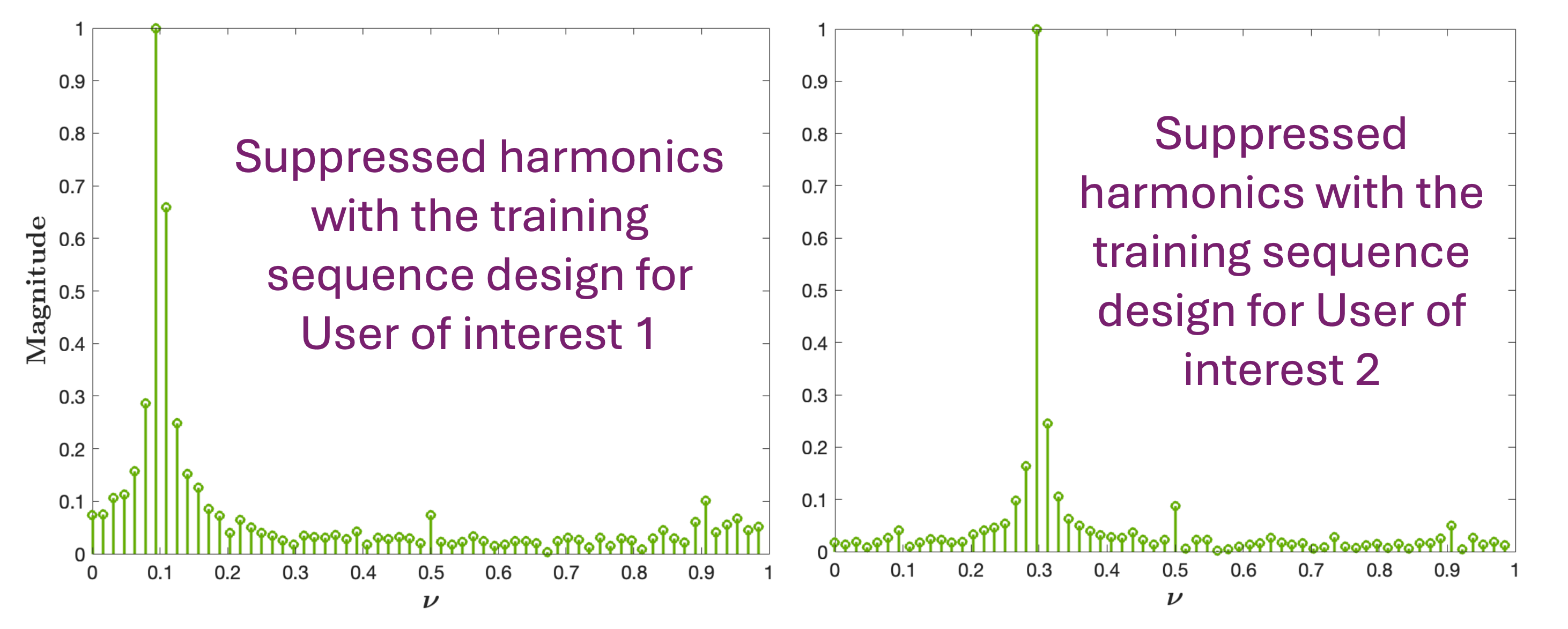
How can we use severely quantized, energy-efficient 1-bit ADCs in massive MIMO systems without losing the Angleof Arrival information to severe spatial harmonics?
ADCs dominate the power and cost budget of digital arrays, making 1-bit quantization an appealing design choice. We develop a Fourier analysis of the spatial harmonics produced by the 1-bit nonlinearity. The analysis yields a concrete design payoff: a ramped-phase training sequence that suppresses higher-order harmonics and isolates the fundamental spatial frequency corresponding to each user's true angle of arrival.
- [1] C. Cebeci, U. Madhow, "A Fourier Analysis of Digital Beamforming with Severely Quantized mmWave Arrays," 57th Asilomar Conference on Signals, Systems and Computers, 2023. [IEEE]
Teaching

Teaching Assistant, ECE 146B, UCSB, Winter 2026
Advanced Topics in Wireless Systems by Prof. Upamanyu Madhow.
Teaching Assistant, ECE 146A, UCSB, Fall 2025
Digital Communication Fundamentals by Prof. Upamanyu Madhow.
Teaching Assistant, ECE 139, UCSB, Spring 2022
Probability and Statistics by Prof. Kenneth Rose.
Teaching Assistant, ECE 130B, UCSB, Winter 2022
Discrete-Time Signal Analysis and Processing by Prof. Upamanyu Madhow.

Tutor, Koç University, Istanbul, Turkey, 2018 – 2019
Held review sessions before exams and office hours to help students and solve example problems for ELEC 201 (Signals and Systems, Spring 2018 – Fall 2019) and ENGR 200 (Probability and Random Variables for Engineers, Spring 2019).
CV
You can find my full curriculum vitae below (Last updated: April 2026). Please don't hesitate to reach out with questions, thank you!
Download my CV